
Two Minutes and Eight Seconds
Inside the room where Hamas's elite fighters got their final orders — and a countdown to the attack.

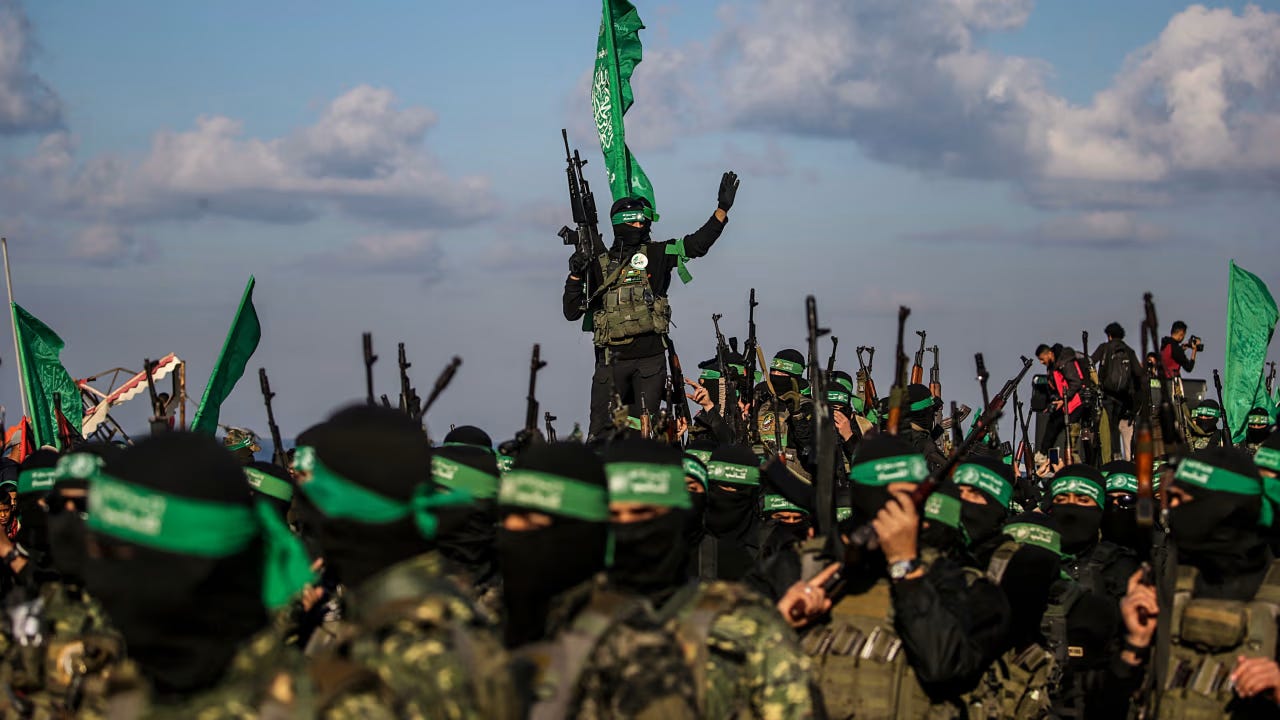
This is an excerpt from The War in Gaza, my forthcoming book on October 7 and its aftermath. El Masry is a fighter in the Nukbah, Hamas's elite special forces unit — his story is semi-fictional. The broader events depicted here — the mobilization, the routes of attack, the timing, the units involved — are drawn from Hamas's own captured attack plan, published reporting, and interviews with Shin Bet officers who investigated the assault. The details of El Masry's own experience — his thoughts, his conversations, the texture of those hours — are my own reconstruction, informed by interviews with Palestinian relatives of Hamas members.
On the afternoon of 6 October, El Masry receives a message – delivered by hand – telling him to be outside an apartment block in Shuja’iyya within the hour, ready to fight.
El Masry and his comrades belong to the third company of the fourth battalion of the Gaza Brigade – also known as the Shuja’iyya battalion, after the neighborhood from which it draws most of its recruits. Formed during the 2009 conflict, the battalion earned a reputation for inflicting casualties on the IDF and has led every flare-up since. The third company belongs to the Nukbah force – ‘elite’ in Arabic – Hamas’s special forces unit. The members of Third Company regard themselves as the elite of an elite, and there has been much speculation among them about what their role will be in the upcoming attack – they have seen the signs. Then, at the end of September, Mohammed Deif himself attended one of their training sessions on the beach, watching them practice breaching the frontier fence and assaulting a mock IDF base made from sheets of corrugated iron and plywood. With fighters acting as lookouts on high ground above the beach to watch for Israeli drones or aircraft, they gathered to hear him speak.
‘You are the tip of our jambiya,’ he said, using the term for the curved dagger worn throughout the Arab world. ‘On a day coming soon – you will penetrate deep into the heart of the Zionist state.’ They cheered as Deif walked among them, hugging some and patting others on the shoulder with words of praise and encouragement. They knew that theirs would be a momentous task – one that would avenge decades of humiliation and bring glory to their families and their cause.
So it is with great excitement that El Masry and the others await the arrival of their team leader, a man they know as Abu Salama. When all are present at the designated rally point, Salama’s deputy sends a messenger to let him know they are ready. Salama appears fifteen minutes later – a large, taciturn man with a full beard instead of the neatly trimmed chin straps worn by the younger Hamas men. Without speaking, he strides through the entrance to the apartment block. They file in after him, cross the lobby, pass through a metal door, and descend concrete steps to the basement. Someone switches on the light, revealing grey concrete walls, ceiling, and floor. Against one wall stands an easel, around which plastic chairs have been arranged. At Salama’s direction they sit. Some, El Masry included, light cigarettes, and soon smoke eddies above their heads in the harsh glare of fluorescent lights. Peering over the heads of those in front of him, El Masry sees a large aerial photograph pinned to the easel. Salama picks up a wooden pointer and checks his watch.
From upstairs comes the clang of the metal door, then the rumble of voices and footsteps on the stairs. Into the room files a dozen or more fighters, blinking in the bright light. El Masry recognizes them – they are a team from the same company. The new arrivals shuffle into place, some taking the remaining chairs, others standing behind, all with their eyes on Abu Salama.
The aerial photograph is large enough for them all to see clearly. It shows the Shuja’iyya neighborhood, the border fence, and the adjacent communities on the Israeli side. At the top, written in red ink, are the words ‘Operation 402.’ Salama gestures to his deputy to close the door and addresses them.
‘Brothers,’ he begins, ‘we have all of us been selected to accomplish a great mission.’
The order he is about to give them, Salama explains, comes from Deif himself. The assembled group – twenty-seven fighters in all – are to attack the kibbutz of Nahal Oz, situated just a few hundred meters from the border fence. Using the pointer, Salama talks them through the plan in detail.
The force will advance toward the target on fourteen off-road motorcycles, moving in two columns. Salama himself will ride in the middle of the convoy, on the back of a motorcycle driven by El Masry’s friend, Bilal Abu Kanuna. On the photograph, a green arrow traces their intended route – starting at the outermost building in Shuja’iyya. Salama follows it with the pointer. Upon passing through the breach points in the fence, they will turn immediately right, travel thirty meters, then turn left toward the east. They will cross potato fields and a watermelon patch, ending at the south-eastern corner of Nahal Oz.
Salama reads their mission statement from a sheaf of typed notes.
‘The mobilized and reduced platoon from the third company in the fourth battalion will attack Nahal Oz kibbutz. It will cause as many casualties as possible, take hostages, and position itself inside the kibbutz – until further instructions are received.’
He then reads the distances and timings specified in section three of the order: ‘Distance of the advance route between the exit point and the target: 3,050 meters. Average speed of the group’s advance towards the target: 40 miles per hour. Travel time to reach the target from when the order is received: 2 minutes and 8 seconds.’
The announcement elicits an excited murmur. Two minutes and eight seconds. That is all it will take to reach their enemy.
Salama runs through the names of fighters assigned specific tasks. There are to be three navigators, though the route is not complicated. The group comprises two teams of ten men apiece, plus an additional seven fighters. Four of these are sappers, whose job it will be to breach obstacles using explosives. The other three are photographers – one of them, a man named Mohammed Hamto, owns a photography studio in Gaza City. Every remaining fighter will be issued with a GoPro camera. It is of the utmost importance, Salama says, to record what they are doing and broadcast the images live. The enemy must see.
Salama pauses to flip up the aerial photograph, revealing another. This one shows the location of IDF communications antennas, cameras, and motion radars, along with guard posts, security fences, and bunkers around the kibbutz. A third photograph provides a close-up of their intended entry point on the south-eastern corner of the kibbutz. It is the point furthest from the Gaza Strip and hidden from the guard towers.
After completing Phase One – movement to target – they will begin Phase Two: the assault. Phase Two will begin with both teams halting approximately fifty meters short of the kibbutz perimeter. They will remain in column on their bikes, except for a security element drawn from each team, which will deploy on either side of the column, set up PKM machine guns, and face outboard to guard against IDF reinforcements.
The sappers will then breach two holes in the perimeter fence using explosive charges. As soon as they hear the detonation, the assault teams will ride through. Firqa One will raid the eastern part of Nahal Oz, taking over the clubhouse, dining hall, and the administrative building known as the secretariat. Salama says it is an important source of intelligence and also houses the kibbutz’s communications systems, which must be destroyed first. While they do this, sappers will plant booby traps along likely avenues of approach for reinforcements.
Firqa Two – El Masry’s team – will attack the western side of Nahal Oz, seizing the visitors’ center, clearing the kindergarten, and destroying the kibbutz’s communications antennas. They will then round up hostages, including those taken by Firqa One, and move them to the kindergarten. They are also tasked with seizing logistics support – food, drink, and fuel – from the kibbutz grocery store.
Salama explains that Firqa Two will call for pickup trucks to take the hostages back to Gaza and then wait for further orders – either to strike deeper into Israeli territory or prepare to ambush IDF reinforcements. He pauses for questions.
‘What about the Zionist outpost next door?’ one of the fighters asks. El Masry has been wondering the same thing. Adjacent to the kibbutz is an IDF lookout position manned by spotters and a platoon of infantry. Salama’s plan calls for their security cameras and communications antennas to be knocked out, but he has not addressed what is to be done with the soldiers inside.
‘A good question, my brother. Behind us will be another two teams from Third Company. They will attack this base and kill the Zionist soldiers before they know what is happening.’
‘Why not give us this mission – to do it first – and have the other team hit the kibbutz?’ asks the same fighter. It is a brave question to put to Salama, El Masry thinks. But Salama appears unruffled. The main objective of the attack, he explains, is to take as many hostages as possible. If they attack the base first, the residents of Nahal Oz will be alerted, making it harder to take hostages.
Another fighter raises his hand. ‘When do we attack?’
Salama allows himself a smile. ‘Tomorrow morning, my brothers.’
They are not allowed to return home after the briefing. Team by team, the fighters file out of the building to their designated assembly area – a nearby football pitch – where they must wait for the attack to begin.
The sub-team leader, whose name is Ahmad, spreads his map out by the goal post and gestures for them to sit around it. They will go through the plan again, he says. El Masry squats in the sand, watching Ahmad. He craves a cigarette, but they are forbidden to smoke. Two men with backpacks emerge from the darkness and go into the apartment building – the drone team. El Masry has watched them practice flying their drones into paper targets attached to wooden poles. They will play a critical role in the attack, but El Masry wouldn’t trade places with them for anything. His team will be in the vanguard of the assault – giving him at last a chance to avenge his family.
Ahmad pulls out a torch and begins talking – going through the plan again, who will be doing what. By now they have all heard it several times and could give it themselves.
‘Today is God’s day, my brothers,’ he finishes. ‘If you have anything to say, say it now. After this, the time for questions is over.’ No one has any.
Until the previous evening, they have not known where they are going or when the attack will take place – but the details they have rehearsed time and again: the order of march, the plan to breach any obstacles, the allocation of tasks at the objective. The firqa is divided into two teams of four men each, plus the firqa leader and his deputy. Each sub-team also has a leader, organized in order of seniority so that when someone is killed or wounded, everyone knows who will take his place. Once they reach their objective, they will follow their sub-team leader and do what he does. In rehearsals they have practiced entering buildings and killing every occupant. They have also practiced taking hostages – putting them on their bikes or in the back of one of the pickup trucks that accompanies every company.
‘In one hour, the attack begins. God be with us all, brothers.’
El Masry returns to his motorcycle and positions it in order of march. He squats and waits, watching as the first glimmer of light appears on the horizon.
Bravo, Andy! This sort of personal narrative helps the reader understand what's happening in a way that briefings meant for professionals absolutely would not have done.